About ±20A/40A/100A Current Booster
Single-channel potentiostat (CS350M/ CS310M/ CS300M etc) can achieve maximum±2A/10V output when it's used alone. A current booster CS2020B/CS2040B/CS2100B can be connected to single-, bi-, or multi-channel potentiostat to increase the current up to 20A/40A/100A.
Product Introduction
Single-channel potentiostat (CS350M/ CS310M/ CS300M etc) can achieve maximum±2A/10V output when it’s used alone. This value is ±1A/10V for each channel of bipotentiostat (CS2350M/CS2150M) and multichannel potentiostat (CS310X).
A current booster CS2020B/CS2040B/CS2100B can be connected to single-, bi-, or multi-channel potentiostat to increase the current up to 20A/40A/100A. Please note that one set booster can boost only one channel of bi- / multi-channel potentiostat.
When not connected the booster, the potentiostat can also be used alone. Please be careful when you operate to avoid electricity shock.
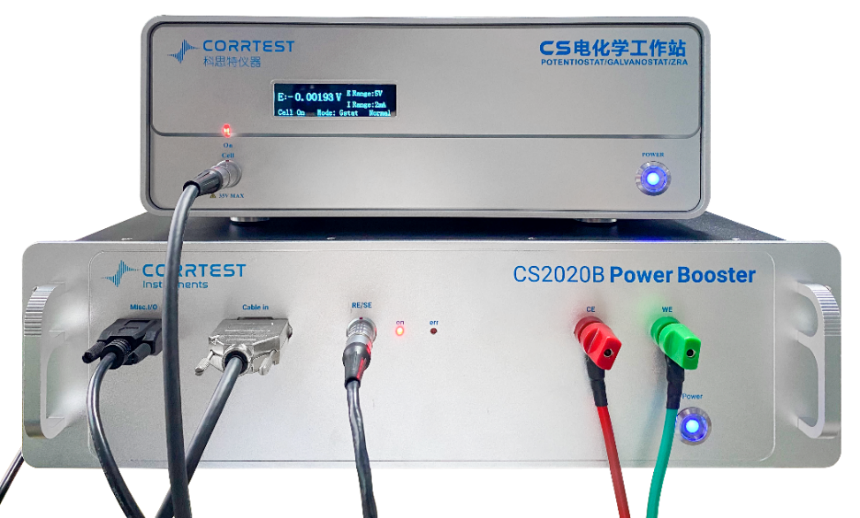
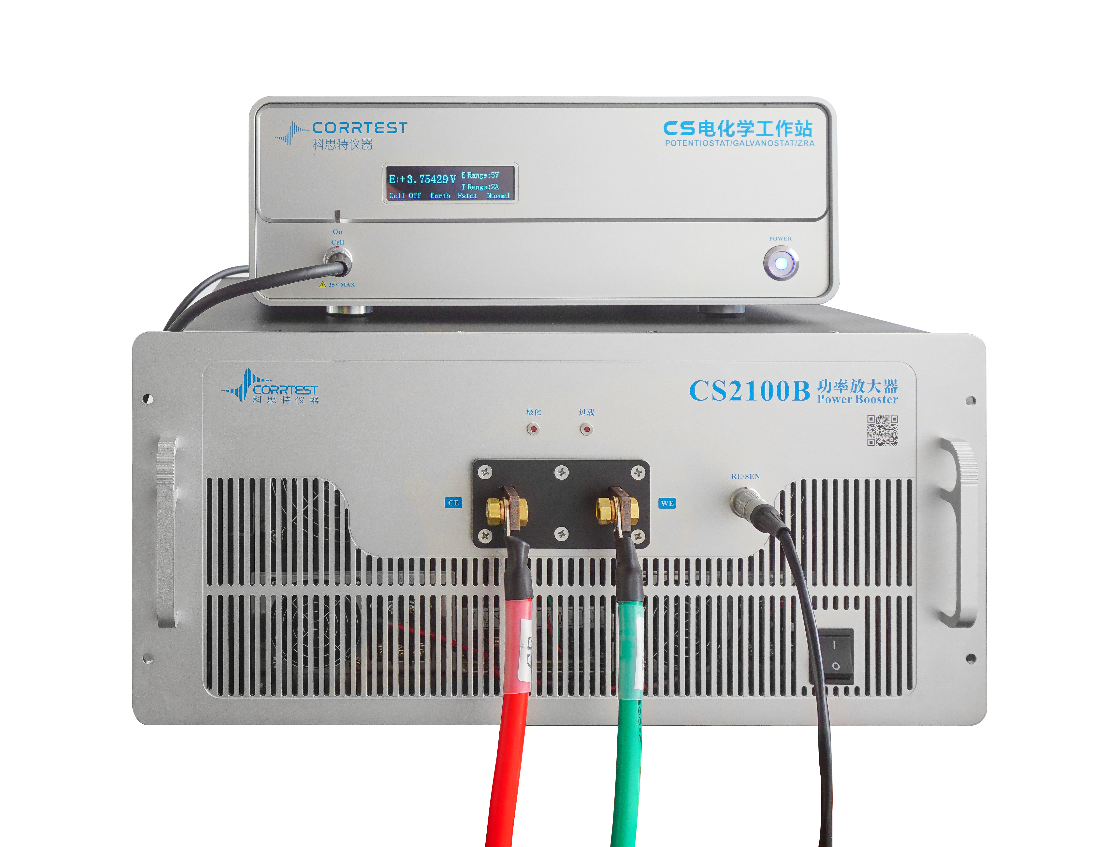
CS2020B/CS2040B/CS2100B current booster +single channel potentiostat (such as CS350M)
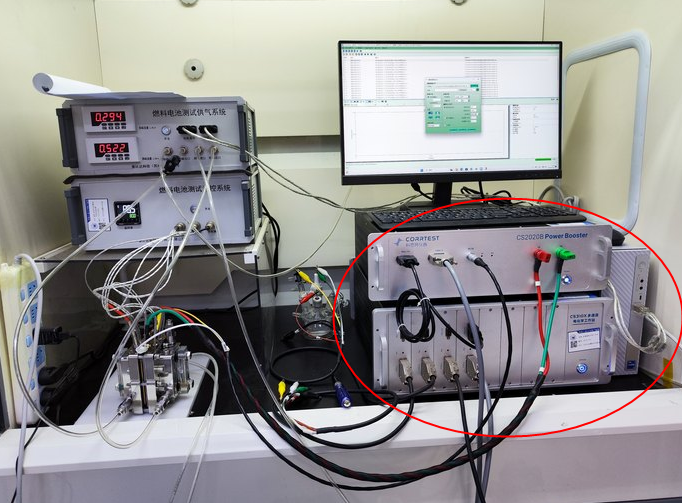
CS2020B current booster +multi-channel potentiostat(framed in red)
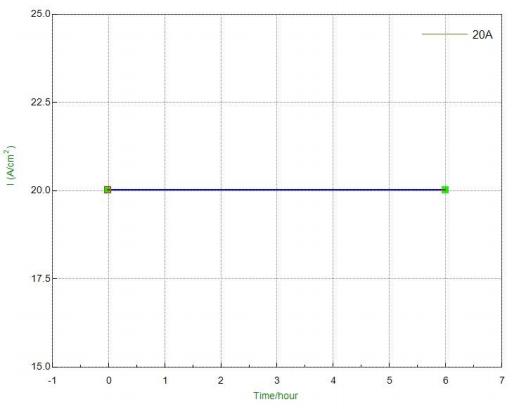
Curve for galvanostatic experiment- output constant current as high as 20A for CS2020B
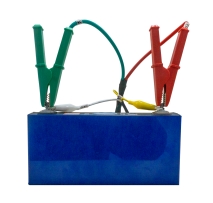
Connection of booster with battery core anode and cathode
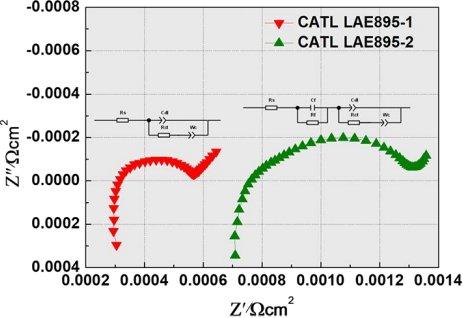
Fig. 3: EIS results of CATL-LAE895 battery core
Experiments examples for potentiostat+40A booster
1. EIS Test of large capacity power batteries
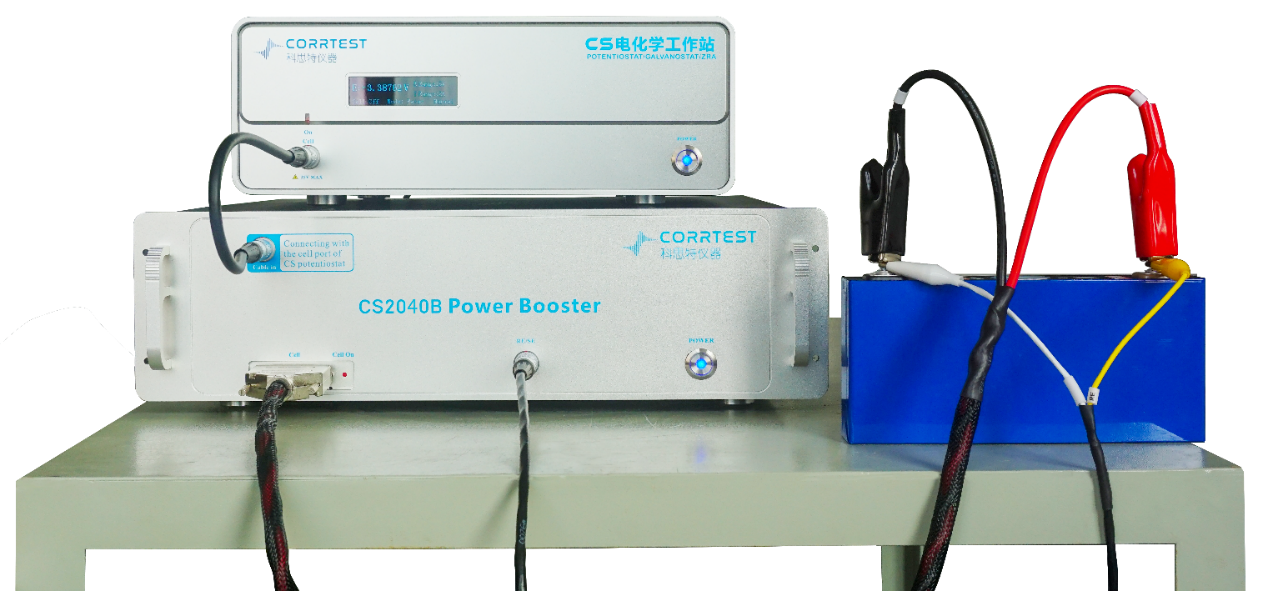
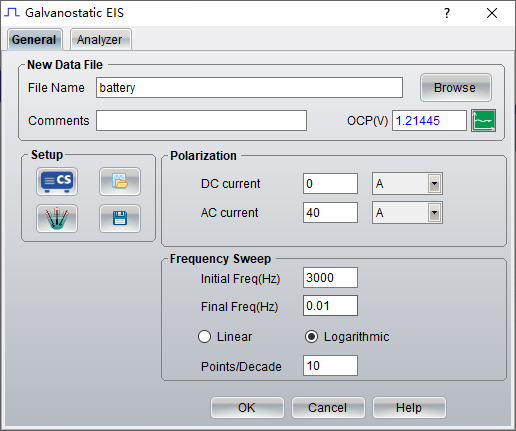
Results
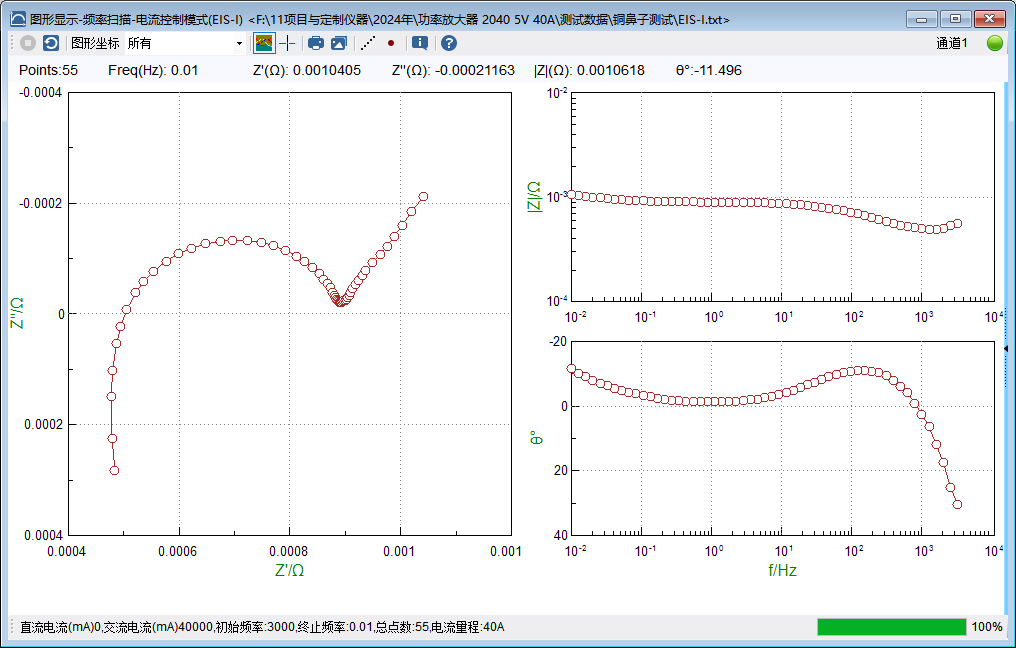
2. PEM water splitting
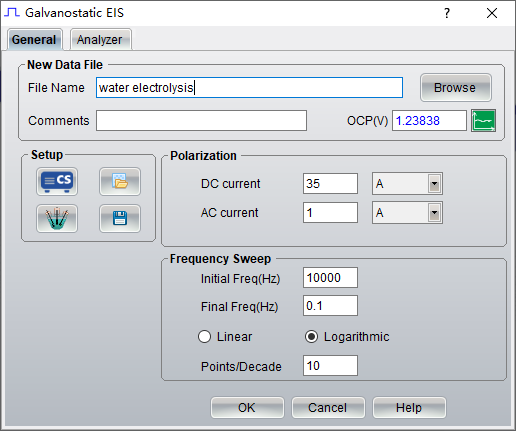
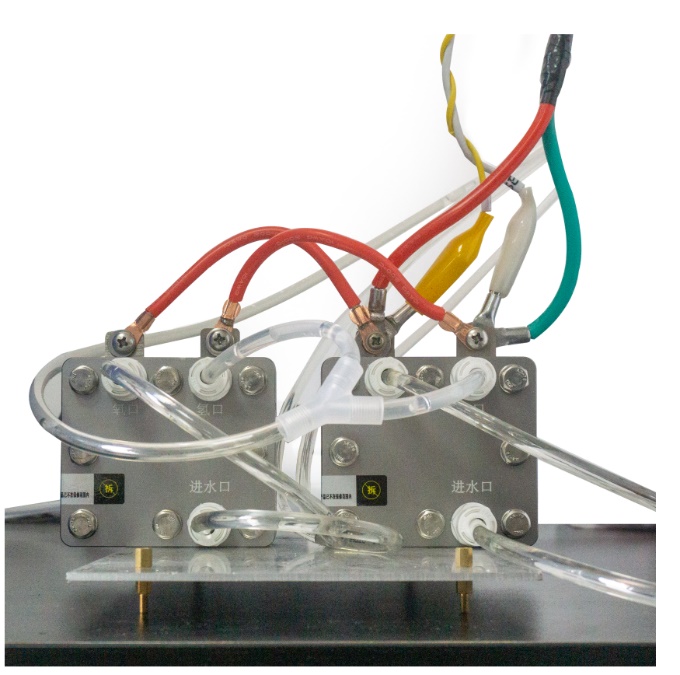
Results

Standard supply for CS2020B/CS2040B/CS2100B booster:
- Current booster instrument*1 set
- Power cable *1 pcs
- DB9 serial port connection cable *2 pcs (1 for replacement in the future)
- DB15 connection cable*2 pcs (1 for replacement)
- Potential sampling cable*2 pcs (1 for replacement)
- Specialized electrode cable (alligator electrode cable*2 and copper terminal electrode cable*2, 1 pcs each for replacement)
- High power dummy cell *1
Specifications
Key specifications (when combination of CS2020B+potentiostat)
Potential range: ±10V(CS2020B) / ±5V(CS2040B) / ±5V(CS2100B)
Current range: ±20A(CS2020B) / 40A(CS2040B) / 100A(CS2100B)
Current range: 20A/40A/100A fixed range
Compliance voltage: ±13V (when output ±20A limit current, maximum output ±10V@20A)
EIS Frequency range: ≤50KHz
Communication: RS485
Techniques
Techniques (when combination of CS2020B+CS350M)
Stable polarization
-
Open Circuit Potential (OCP)
-
Potentiostatic (I-T curve)
-
Galvanostatic
-
Potentiodynamic (Tafel plot)
-
Galvanodynamic (DGP)
Transient Polarization
Chrono Method
-
Chronopotentiometry (CP)
-
Chronoamperametry (CA)
-
Chronocaulometry (CC)
Voltammetry
Electrochemical Impedance Spectroscopy (EIS)
Battery test
-
Battery Charge and Discharge
-
Galvanostatic Charge and Discharge (GCD)
-
Potentiostatic Charging and Discharging(PCD)
-
Potentiostatic Intermittent Titration Technique(PITT)
-
Galvanostatic Intermittent Titration Technique(GITT)
Corrosion Measurements
-
Cyclic polarization curve (CPP)
-
Linear polarization curve (LPR)
-
Electrochemical Potentiokinetic Reactivation (EPR)
-
Electrochemical Noise (EN)
-
Zero resistance Ammeter (ZRA)


