Platinum Screen Electrode 002250
The Platinum Screen Electrode (Gauze Electrode) offers large surface area in little space. It is indicated for exhaustive electrolysis, coulometry and as a large area counterelectrode, when the counterelectrode cannot limit the cell current.
Applications
- Exhaustive Electrolysis (Bulk Electrolysis) and Electrochemical Synthesis
- Coulometry
- Counterelectrode in High Current Tests
Specifications
| Code |
002250 |
| Material |
Platinum screen |
| Insulation |
PEEK |
| Mesh |
80 mesh |
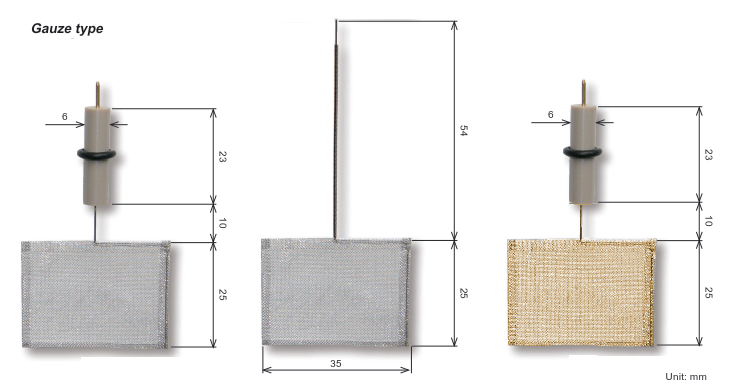
| Screen Dimensions |
25 × 35 mm |
Use with
Mass Electrolysis Cell (001197) and platinum Counterelectrode (002233).
FAQ
What is a Platinum screen electrode?
It is an electrode made of a mesh of platinum wires. The mesh offers a lot of surface area in low volume, which allows you to work with high currents and distribute the current evenly in the solution.
What is the use of exhaustive electrolysis?
In the exhaustive electrolysis (bulk electrolysis) the objective is to convert the entire electroactive species of the solution. The large screen area speeds up this conversion and shortens the test time.
Can I use it as a working electrode?
Yes, in exhaustive electrolysis, coulometry and electrochemical synthesis it is usually the working electrode. For analytical voltammetry, prefer a disk electrode, because the actual area of the screen is difficult to define accurately.
Why use it as a counterelectrode?
The counterelectrode must have an area much larger than the working electrode, so that the reactions in it do not limit the cell's current. The platinum screen fulfills this role in high current tests.
What does 80 mesh mesh mean?
Means 80 apertures per linear inch of the screen. It is a thin mesh, which combines large surface area with good passage of the solution.
What are the dimensions of the screen?
The screen area measures 25 × 35 mm.
What is PEEK insulation for?
The PEEK isolates the electrical contact from the solution, so that only the platinum participates in the reaction. It is a polymer with good chemical resistance to most organic acids, bases and solvents.
What electrolytes can I use?
Platinum is stable in acidic, neutral and alkaline aqueous solutions and in many organic solvents. Avoid royal water and beware of chloride media in very anodic potentials, where the platinum can slowly dissolve.
What is the potential window in aqueous medium?
It is limited by the evolution of hydrogen on the cathode side and oxygen on the anodic side. As platinum has a low overvoltage for hydrogen, the cathodic window is narrower than that of vitreous carbon.
How to clean the electrode?
Rinse with deionized water after each use. For deeper cleaning, use dilute acid or cycling in diluted sulfuric acid until you get the characteristic voltamoscope of platinum, according to your laboratory protocol.
Can I flam or heat the electrode?
No. Buckling is common for pure platinum, but PEEK insulation can't stand the flame.
How to prevent screen damage?
Do not bend or knit the mesh, do not touch the screen with your fingers and store the dry and protected electrode.
Do I need to separate the counterelectrode from the working electrode?
In the exhaustive electrolysis, yes: use a cell with compartments separated by frying or membrane, so that the products formed in one electrode do not react in the other.
Does it work with any potentiostat?
Yes. It is a passive electrode, connected to the working electrode cable or the potentiostat counterelectrode. On high currents, check the maximum current that your potentiostat supports.
Which accessories suit him?
The mass electrolysis cell (001197), the platinum counterelectrode (002233) and a reference electrode suitable for its medium.
Need another size or help mount the cell? Talk to LabSolutions: Technical Support in Electrochemistry and shipping throughout Brazil.
Technical Drawing