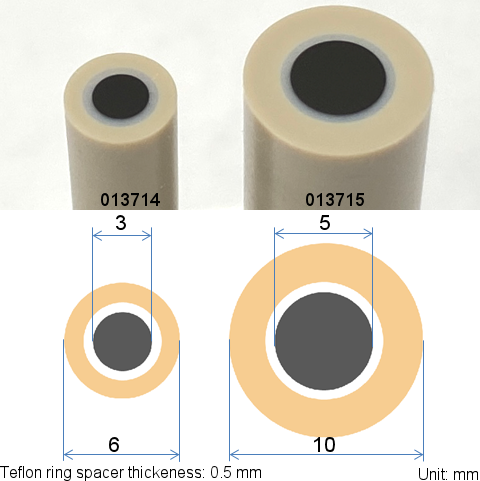
Glassy carbon electrode with Teflon ring
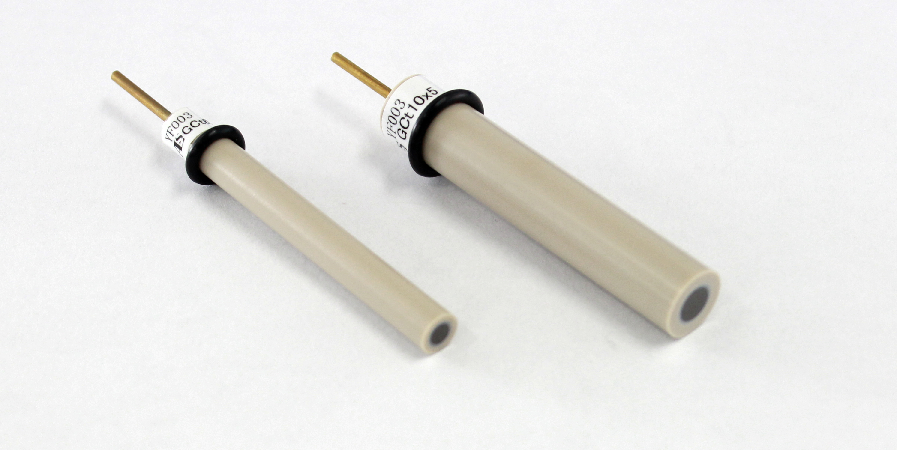
Feature
• Conventional electrode
• Wide over-potentials for oxygen and hydrogen evolution
• Chemically stable
• Improved to facilitate the handling to obtain a chemically modified electrode
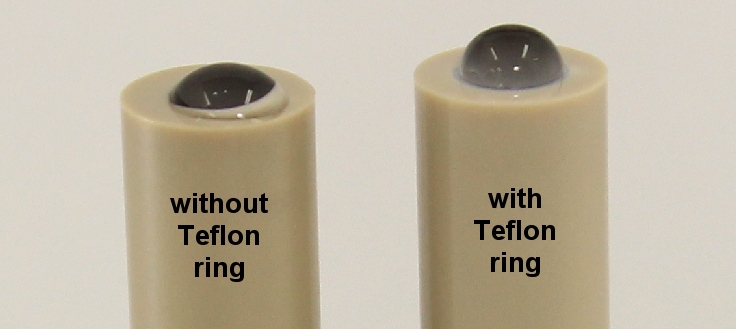
For the GCEt Glassy carbon electrode, a Teflon spacer was included between the PEEK insulation and glassy carbon disk. For the property of the material, it will avoid that the sample spreads, to get the chemically modified surface.
| Catalog No. |
Description |
Isolation |
OD |
ID |
| 013714 |
GCEt Glassy carbon electrode |
PEEK |
6 mm |
3 mm |
| 013715 |
GCEt Glassy carbon electrode |
PEEK |
10 mm |
5 mm |
Customized electrode is also available. Any electrodes are developed for utilization at normal temperature and pressure. Please look carefully through the attached operation suggestion before hand.
Frequently asked questions
What is a glassy carbon electrode?
It is a working electrode made of glassy carbon, a hard, gas-impermeable and chemically inert material. It is the most widely used working electrode in voltammetry.
What is the Teflon ring for?
It sits between the PEEK insulation and the glassy carbon disk and keeps the sample drop from spreading. This makes it easier to prepare chemically modified electrodes, for example by drop-casting a catalyst ink.
Which sizes are available?
013714: 3 mm disk, 6 mm body. 013715: 5 mm disk, 10 mm body. Both with PEEK insulation.
Which size should I choose?
The 3 mm disk is the standard for voltammetry and uses less sample. The 5 mm disk has more area, gives higher currents and makes it easier to deposit films and catalysts.
What is the potential window?
Wide. Glassy carbon has high overpotentials for oxygen and hydrogen evolution, which extends the usable potential range.
What is it used for?
Cyclic voltammetry, electroanalysis, sensors, electrocatalysis and studies with modified electrodes.
How do I polish it?
Use alumina slurry on a polishing pad, in decreasing particle sizes, with figure-eight motions. Then rinse thoroughly with deionized water.
How often should I polish it?
Before each series of measurements, or whenever your reference voltammogram shows a loss of performance.
How do I check the surface?
Run a cyclic voltammogram in ferri/ferrocyanide: on a clean surface the peak separation is close to that of a reversible system.
Can I use it in organic solvents?
Yes. Glassy carbon, Teflon and PEEK have good chemical resistance to the solvents most used in electrochemistry.
Under what conditions can it operate?
The electrodes are designed for use at room temperature and normal pressure.
Does it work with any potentiostat?
Yes. It connects to the working electrode lead of any potentiostat.
Can I use it as a rotating disk electrode?
No. This is a conventional, stationary electrode. For hydrodynamic measurements, use the dedicated RDE/RRDE electrodes and rotator.
Are custom sizes available?
Yes, customized electrodes are available on request.
What else do I need for a complete cell?
A platinum counter electrode and an Ag/AgCl reference electrode, plus a polishing kit.